显示标签为“pigment ink”的博文。显示所有博文

2019年4月25日星期四

Inkjet Ink-How to Pick It Correctly When Digital Textile Printing

Do you know how to choose a inkjet ink for your inkjet printer?Here are some ways to help you pick it correctly.

1.Definition of digital textile printing

 Pigment Ink
Pigment Ink
Digital printing is similar to using a printer to print on a piece of paper, but the intended medium is textiles for use in shirts and blankets. Printing with a digital textile machine offers advantages over traditional methods in that new colors and designs can be added to the fabric. Some fabrics are porous and absorb ink, and others are not, so a non-bleeding unit must be added to the digital textile printing unit so that these other fabrics do not bleed after printing. The disadvantages of this type printing are from spot coloring inaccuracy, slower printing times and difficulty in digital setup.
This type of printing is nearly the same as using a regular printer. Most textile printers look like a wide-format poster printer and have a roll of fabric attached to the back. When the operator loads an image into the computer and prints it, the textile printer draws in fabric from the roll and then uses an ink-loaded carrier that moves back and forth to get the ink onto the fabric.


2.How to correctly select ink for inkjet printer

Textile inkjet inks are split into four main categories, each with chemical and physical properties specifically designed to work with the target fabric.
1) Reactive dye-based inks (or reactive inks) are ideal for printing cotton, linen, silk and plant derived fibers such as hemp and jute. Reactive inks have good light fastness as well as typically bright colours. Wash fastness is also good due to the chemical bond created between the dye and the fabric. Readily available and inexpensive pre-treated fabrics are often used when printing with reactive inks, although major manufacturers often do their own pre-treatment.  After printing, these inks need to be post-treated by steaming and washing.
2) Acid dye-based based inks (acid inks) are designed for printing nylon, silk, wool and even leather. They are used to manufacture sportswear, swimwear, lingerie, flags, banners and accessories including ties and scarves. Like reactive inks, acid based inks are also bright but typically have better light fastness. Wash fastness is also good due to the strong bond created between the substrate and dye stuff. Pre-treated fabrics and post-process steaming and washing are also a necessity.
3) Disperse dye-based inks (disperse inks) are used for printing polyester fabrics. They are generally not as bright as acid and reactive inks. When heated to high temperatures the dye becomes gaseous and is absorbed into the polyester fibers. As the dye cools and condenses it gets trapped in the fibers, making fabrics printed with disperse inks highly resistant to laundering. 
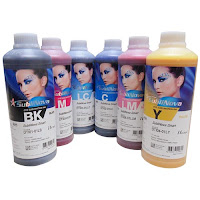
Disperse inks are typically divided into low and high energy inks. The former (also known as dye sublimation inks) have good light fastness and can be printed onto paper and then transferred to polyester or printed directly on the polyester itself and heated in an oven or transfer press. Due to their excellent light fastness, high energy direct disperse inks are often chosen for the most taxing outdoor applications such as lawn furniture. All high energy disperse inks must be printed direct to fabric and then undergo heat fixation.
 Inkjet Ink
Inkjet Ink
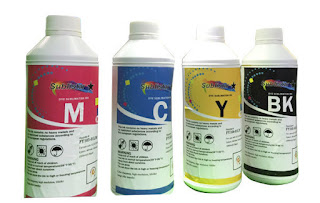
4) Pigmented inks use a pigment (insoluble in the ink carrier) rather than a dye (soluble in the ink carrier) to provide coloration. They contain resin binders which help the pigment particles to adhere to the fabric, meaning that the inks can be used across a very wide range of fabric types. However, the inclusion of resin in the composition can limit the amount of pigment possible, as both components raise the ink viscosity. Typically inks with high amounts of colour have low amounts of resin and thus low wash fastness. Conversely, pigment inks with good wash fastness often have higher resin and lower colour intensity. The binder properties and concentration also need to be chosen carefully to avoid affecting the 'feel' of the fabric. Pigment inks typically have very good light fastness and the ability to be used on a wide range of fabrics is a significant advantage. UV curing or heating is sufficient for fixation, and so the inks are simple to use.

We should use the appropriate digital textile ink according to the printed materials , it will print the best images.


More Info:
Company Name: Fei Yue Digital Technology Co.,LTD
Tel: 86-025-86628894
Whatsapp: +86 15007920742
Address: Central Road 323, Nanjing, Jiangsu, China

2019年4月3日星期三

Dye Ink VS Pigment Ink, Which One Is Your Best Choice

Most inkjet printers use dye inks, but some photographers prefer pigment ink for a variety of reasons. Let's talk about the advantages of them and which one is better for digital printer.
Dye-based VS Pigment-based Ink: Let's Know the Difference of Them
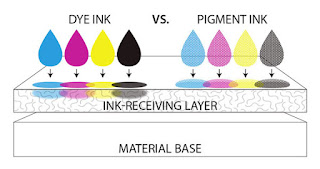
Dye Ink VS Pigment Ink


What is dye-based ink?

Dye-based ink uses colour substances that are dissolved in a liquid while pigmented ink uses small colour particles that are held in a suspension. The water soluble dye can be seen as sugar that dissolves in water and the pigments as sand mixed in water.


What is pigmented ink?

 Dye Ink
 Dye Ink
Pigments are dry, powdery crystals that must be mixed with a liquid before being applied to paper. Like industrial printing ink, pigment dyes are typically oil-based for their water- and fade-resistant properties, especially good on slick surfaces like transparencies and glossy brochures. Pigment dye printers apply a layer of color that lies on top of the page instead of being absorbed into the paper. After the pigment particles and solution mix coats the paper, the printer uses a combination of heat and pressure to evaporate the liquid and permanently attach the pigment to the paper.


The pros about dye-based Inks:

  • It has been around longer than pigment-based inks.
  • Because of its age, dye-based ink is more affordable.
  • Dyes have a wider color range and accuracy of color, and are the standard ink type used in most inkjet printers.
  • Printers that utilize it will produce prints more vibrantly, pictures tend to look more realistic then pigmented inks.

The pros about pigmented Inks:

  • This inks are pigments of color that are ground down very finely and then suspended inside a liquid in order to create ink.
  • It will most likely last longer.
  • The colors are stored inside the pigments, acting like a barrier to external forces like evaporation or oxidation.
  • The preservation of color is the main advantage.
So after going by all the characteristics and differences in the inks, it is advised to use Pigmented ink for heat transfer paper. The reason for using a pigment ink over the regular dye ink is that the pigment ink doesn't fade quickly. It can also resist humidity and can be used for printing on the T-shirts using the right heat transfer paper. There are heat machines available that allow to press the pigment on the T-shirt using a heat transfer paper.


Which one is your best choice?

Each printer you buy will be able to hold a specific type of ink and so it is important that you do not use pigmented inks in dye based ink printers and vice versa. You should only use printer cartridges that contain the ink type that is specified in your printer document.
If longevity is the most important factor that you look for, pigment-based inks are the better option for you. However if you need printouts that display brilliant colors, dye based inks are the better option (and the option that you will find in most color inkjet printers today). If you are only printing in black and white, you may find that the other benefits offered by pigmented inks make them the best choice, and so you should make sure that your black ink cartridge contains pigment based ink when purchasing.

The type that you ultimately choose will depend on the type of printer that you own and the type of printing that you plan on doing.


More Info:
Website: www.skyimagepaper.com
Company Name: Fei Yue Digital Technology Co.,LTD
E-mail: sales@feiyuepaper.com
Tel: 86-025-86628894
Whatsapp: +86 15007920742
Address: Central Road 323, Nanjing, Jiangsu, China